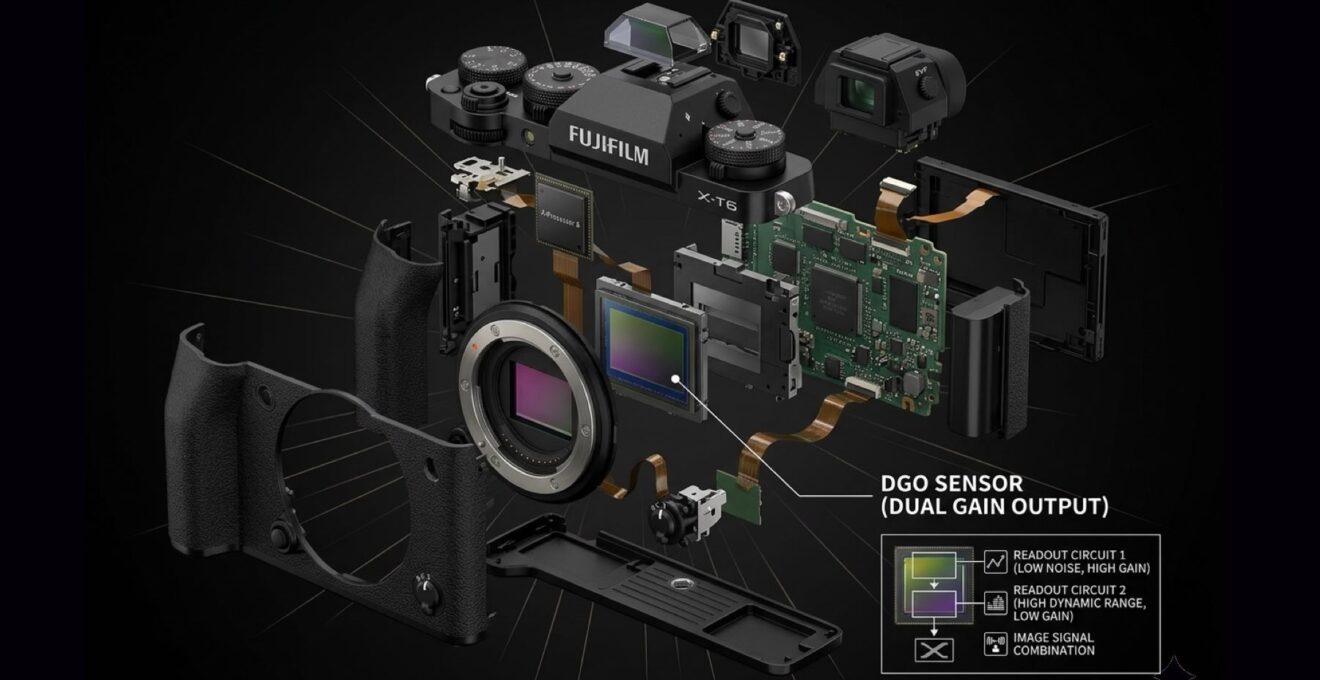
Recently, the paradigm of sensor technology advancement in the digital camera market has shifted beyond the resolution race toward maximizing "dynamic range (DR)" and "noise reduction." At the center of this buzz is 'DGO (Dual Gain Output)' sensor technology, which has primarily been adopted in high-end video equipment such as Canon's Cinema EOS lineup and ARRI.
What kind of innovation would occur if this DGO technology were introduced to Fujifilm's unique APS-C format (X-series) and medium format (GFX series)? Based on an in-depth analysis by FujiRumors, a global camera news outlet, this report explores the possibilities, limitations, and future of this potential integration.
1. What is a DGO (Dual Gain Output) Sensor?
Traditional 'Dual Native ISO (DCG)' technology functions by 'selecting' either a high-sensitivity or low-sensitivity circuit depending on the shooting environment before capturing an image. In contrast, a DGO sensor reads out a single pixel signal simultaneously through two different amplifiers (High Gain / Low Gain) in real time.
- High Gain: Captures rich details in dark shadow areas while suppressing noise to the absolute minimum.
- Low Gain: Preserves information in bright highlight areas to prevent clipping.
The camera combines these two sets of data in real time to produce a single, final image boasting an overwhelming dynamic range and clean shadow details.
2. Scenarios for APS-C (X-Series) Integration
Fujifilm X-series users have often felt limited by the depth of field and dynamic range inherent to the smaller sensor size compared to full-frame alternatives. If a DGO sensor is packed into the next-generation X-T6, X-H3, or X-Pro4, it could completely change the game.
- Dynamic Range Surpassing Full-Frame: Breaking through the limitations of the APS-C format, it becomes possible to secure a cinema-grade dynamic range of up to 16 stops. This maximizes editing latitude even in extreme backlit or high-contrast outdoor settings.
- Dramatic Leap in Low-Light, High-ISO Performance: The typical issue of increased night noise in higher-resolution sensors is drastically improved thanks to DGO's real-time shadow noise reduction. This could be the key to breaking the formula of "high resolution = high low-light noise."
3. Scenarios for Medium Format (GFX Series) Integration
If DGO technology is paired with the GFX medium format system—already considered the pinnacle of image quality—it will yield unprecedented results in commercial photography and high-end cinematography.
- Flawless Commercial and Landscape Photography: The overwhelming resolution unique to the GFX system combined with DGO’s perfect tonal gradation will capture richer colors and light than the human eye can perceive, from the deepest shadows to the brightest highlights.
- A New Powerhouse in the Cinema Market: Given Fujifilm's recent heavy investments in video production utilizing the GFX system (such as developing cinema lenses), a medium format cinema camera equipped with a DGO sensor could heavily disrupt the high-end video market currently dominated by ARRI and RED.
4. Real Obstacles Behind a Rosy Future
Of course, adopting DGO sensors is not without its challenges. FujiRumors and industry experts point out several distinct technical limitations.
- Data Processing Speed and Heat Dissipation (Continuous Shooting Limits): Because the camera must read double the data and synthesize it in real time for every single frame, it places an immense load on the image processor (X-Processor). This inevitably leads to high battery consumption and "overheating" issues, posing a major hurdle for implementing the high-speed continuous shooting (stills) essential for sports photography.
- Increased Sensor Production Costs: Due to the technical complexity, sensor manufacturing yields could drop, causing prices to spike. Higher body prices would ultimately translate into a heavier financial burden for consumers.
📷 Editor's Note
"A DGO sensor is the most attractive card Fujifilm can play to overcome its 'sensor size disadvantage' through pure engineering. Rather than press-oriented camera bodies that require high-speed continuous bursts, it is highly likely to be applied first to the video-centric lines of the X-H series or next-generation GFX models that chase the ultimate limits of image quality and cinematography. If Fujifilm can solve the homework of heat dissipation and processing speed, the balance of power in the mirrorless market could shift once again."
#Fujifilm #DGOSensor #DynamicRange #FujifilmX #FujifilmGFX #CameraTech #Mirrorless #XT5 #GFX100II #CameraRumors