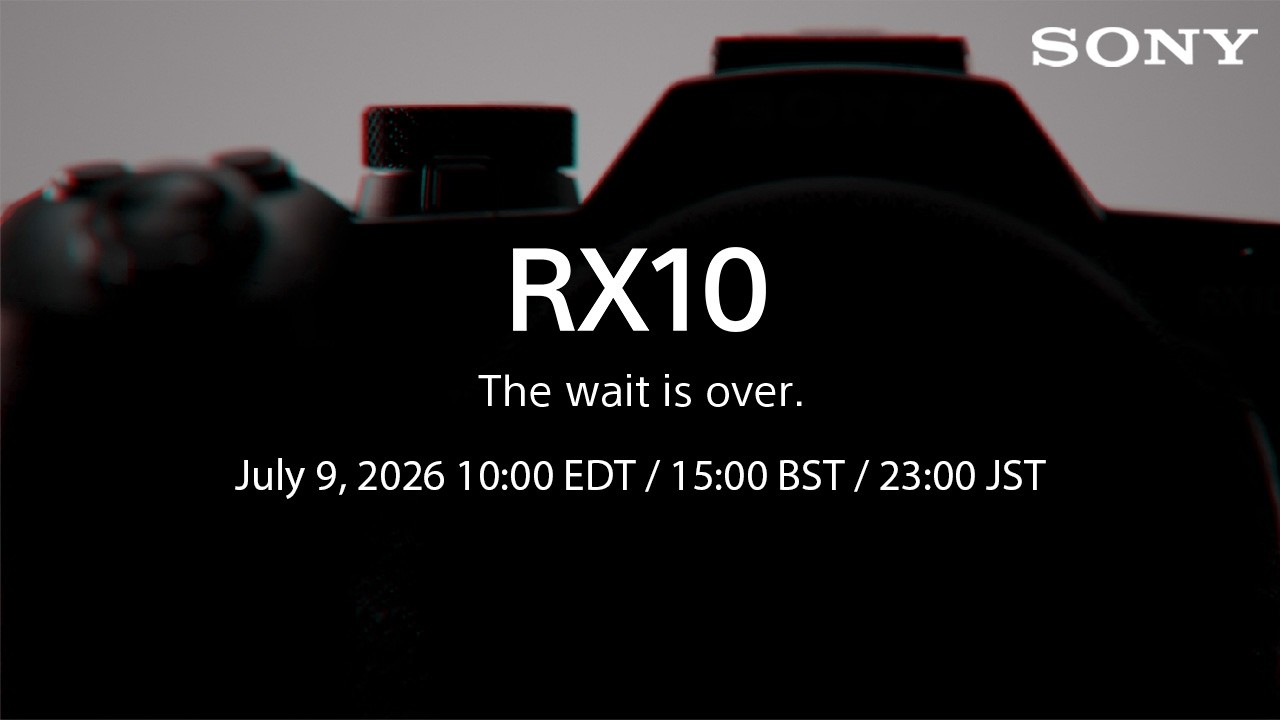
The launch of the ‘Sony RX10 Mark V (RX10V)’—the next-generation successor to the absolute ruler of the all-in-one bridge camera market—has officially entered its final countdown. According to key intelligence surfaced by SonyAlphaRumors, the upcoming RX10V is taking a highly strategic route: rather than introducing entirely new glass, it is executing a massive hardware overhaul by completely replacing its internal image processors and computational engines. With Sony recently dropping an official global teaser video confirming the return of this fabled series, the international imaging community has officially reached a fever pitch.
1. “The Wait is Over”... Sony Abruptly Drops Official Teaser, Ending 9 Years of Silence!
Sony recently shocked the market by uploading a striking silhouette teaser on its official YouTube and Instagram channels captioned: “The wait is over. A new RX10 is coming 7/9/2026.”
- Global Announcement Locked for July 9: This marks a glorious resurrection for the RX10 series, which had been plagued by discontinuation rumors following a nearly 9-year hiatus since the late-2017 debut of the RX10 IV.
- Clues Hidden in the Silhouette: The official teaser video clearly tracks the distinct, muscular form factor of the camera as its inner barrel extends forward upon power-up. Crucially, a close-up glimpse of the lens barrel revealing physical aperture markings running from f/2.4 to f/16 cleanly backs up running rumors that Sony is retaining its legendary, proven ZEISS Vario-Sonnar high-magnification optical formula.
2. Keeping the Bones, Replicating the Brain: The Marriage of ‘Dual BIONZ ZR’ and a Dedicated ‘AI Chip’
Sony’s core strategy with the RX10V centers on maintaining established optical geometries to manage retail pricing while aggressively elevating raw computational speed. The goal is to transplant top-tier full-frame Alpha mirrorless performance directly into a fixed-lens footprint.
- A Bridge Camera First—Dual Processors: For the first time in its premium compact history, Sony is implementing a next-generation ‘Dual BIONZ ZR’ image processing array. This parallel-computing architecture completely bypasses previous data throughput bottlenecks, allowing the system to buffer massive data pipelines effortlessly.
- Flagship-Tier Deep Learning Hardware: Working alongside the main processing core is a dedicated AI Processing Unit (AI Chip)—the same deep-learning silicon powering elite mirrorless platforms like the $\alpha$9 III and $\alpha$7R V. This unlocks Sony's absolute latest Real-Time Subject Recognition tracking matrix, allowing the camera to lock onto humans, animals, birds, insects, vehicles, trains, and aircraft with flawless accuracy. Wildlife trackers will now enjoy unparalleled Eye-AF tenacity even at extreme super-telephoto ranges.
3. Smashing Fixed-Lens Boundaries: 4K 120p and Cinema-Grade Video Profiles
While legacy 1-inch sensor compacts historically capped their video capabilities at 4K 30p or 60p due to thermal limitations and processing strain, the RX10V leverages its dual-engine architecture to redefine the video performance of bridge cameras.
- Cinematic High-Frame-Rate Capture: The system introduces highly fluid 4K 120fps recording with minimal crop factoring, alongside a blistering 240fps readout in Full HD for smooth slow-motion capture.
- Professional Workflow Integration: To position the camera as a dependable secondary tool on commercial sets, Sony has baked in a wide-latitude S-Log3 gamma curve alongside native User LUT loading capabilities—enabling directors to monitor finalized color grades directly on location.
4. Ergonomics Tuned to the $\alpha$9 III Blueprint
- Tactile Grip and Custom Layouts: The physical handgrip has undergone an ergonomic redesign modeled after the flagship $\alpha$9 III and $\alpha$1 II chassis, providing exceptionally secure handling when tracking far-off subjects at maximum telephoto extensions. The top plate has also been refreshed with two dedicated Custom (C) buttons for flexible, user-defined feature mapping.
- Modern Power Delivery: Phasing out the antiquated Micro-USB port of yesteryear, the body now features a modern USB-C interface supporting ultra-fast data transfers and continuous USB-PD (Power Delivery) field charging, significantly boosting operational endurance on remote assignments.
✍️ Editor's Note
"While early whispers that the core sensor and lens geometry would remain unchanged initially drew a collective sigh from some corners of the internet, a closer look at the official YouTube teaser reveals that Sony is playing an exceptionally smart game of chess. The legacy ZEISS super-zoom optic remains an absolute masterpiece of optical design even by modern standards. Rather than re-engineering the glass from scratch and forcing the retail price to skyrocket, Sony chose to drop a roaring new heart inside the chassis via the 'Dual BIONZ ZR' system and a dedicated 'AI Chip.' Unlocking 4K 120p, S-Log3, and custom LUT mapping on a 1-inch fixed-lens camera isn't a mere iterative update—it's a disruptive play that directly encroaches on the run-and-gun professional camcorder market. Pair that with flagship-tier AI tracking and an ultra-comfortable $\alpha$9 III-style grip, and you have the ultimate all-in-one cheat code for hybrid creators tired of hauling heavy telephoto glass and swapping prime lenses in the field. The nine-year intermission was well worth the wait. July 9th cannot arrive fast enough!"
#Sony #SonyCamera #RX10V #SonyRX10M5 #SonyTeaser #OfficialTeaser #BridgeCamera #SuperZoom #4K120p #BIONZZR #AIChip #RealTimeTracking #ZeissLens #TelephotoPhotography #SonyAlphaRumors #CameraGear #VideoProduction #NewGearAlert #July9Announce