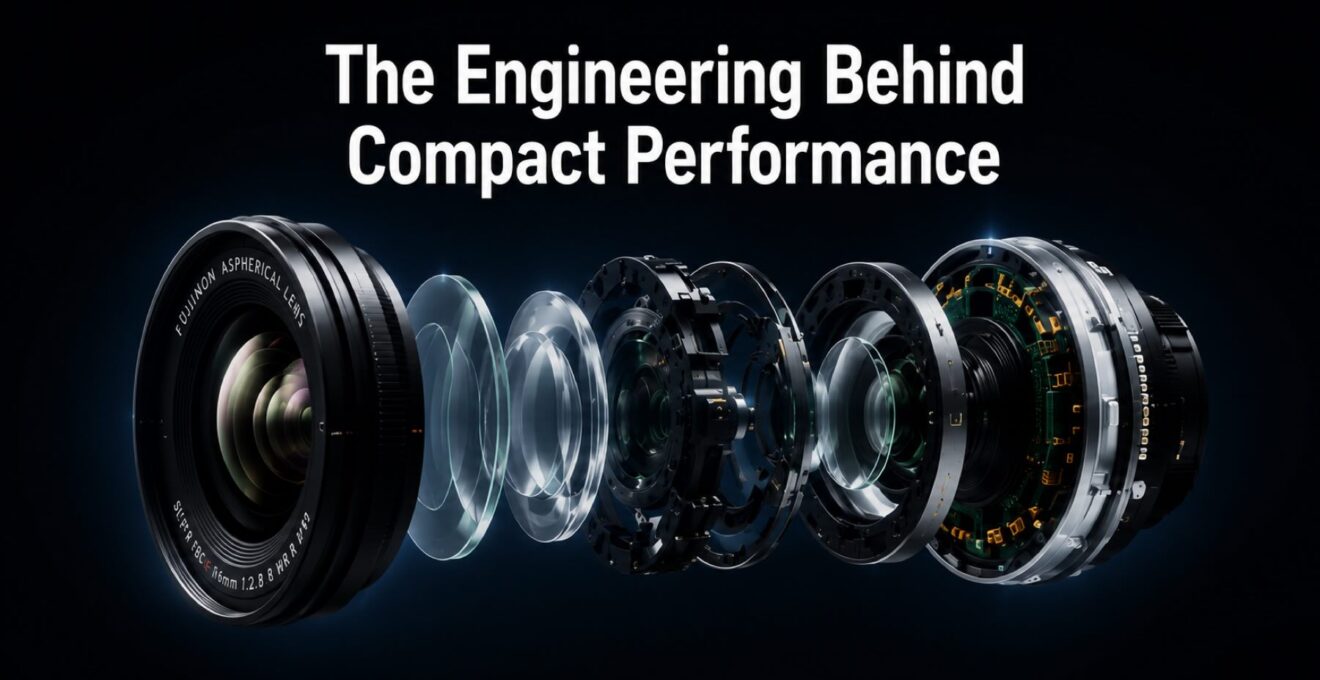
The most welcoming recent trend in the camera market is, without a doubt, "lightweight and compact lenses." A prime example is Fujifilm’s new XF16-55mmF2.8 II lens, which shed a whopping 37% of its weight compared to its predecessor while delivering even sharper image quality. How did they break the long-standing formula that big, heavy glass guarantees high resolution? Let’s dive into the core technological secrets behind how manufacturers are slimming down lenses without sacrificing image quality.
1. Advanced Optical Simulation and High-Precision Aspherical Elements
In the past, manufacturers had to layer numerous glass elements to correct various optical aberrations, which inevitably made lenses heavy and bulky. Today, however, they utilize highly advanced computer optical simulations to find the absolute optimal lens arrangement to suppress aberrations. In particular, the design and manufacturing of "high-precision aspherical lenses"—which bend light accurately without distortion—have evolved dramatically. Now, just a few specialized elements can replace the role that dozens of glass sheets used to play.
2. Mirrorless Advantages: A Shorter Flange Back
During the DSLR era, the distance between the rear lens element and the sensor (the flange back) was forced to be long due to the internal mirror box. Mirrorless systems completely eliminated this restriction, drastically shortening that distance. By positioning the rear elements extremely close to the image sensor, it has become much easier to secure peripheral sharpness and light volume without making the physical lens housing larger, especially for wide-angle and standard zoom lenses.
3. Miniature Motors and Inner Focusing Systems
The design of the focusing groups that move inside the lens has also transformed. Instead of the massive, heavy motors of the past, compact yet powerful linear motors have been introduced. Along with this, "Inner Focusing" technology—where only a specific, smaller group of internal elements moves to achieve focus rather than the entire lens barrel—has become highly sophisticated, dramatically reducing the overall size and weight of the lens.
4. Lightweight Materials and Smarter Digital Corrections
High-strength, lightweight engineering plastics and carbon fiber materials have actively replaced heavy metals, trimming weight while maintaining durability. Furthermore, instead of forcing the glass elements to correct every single optical limitation like distortion or peripheral illumination drop, a "hybrid approach" has firmly taken root. This system combines the camera body’s powerful processor and firmware (digital correction technology) with the optics to achieve flawless final image quality.
As a result, today’s photographers are living in a technologically blessed era where they can enjoy peak performance with a lighter load, free from the old worry that "lightweight means lower quality."
✍️ Editor's Note
"No matter how light camera bodies become, if the lenses remain as heavy as bricks, the benefits of a mirrorless system are only half-realized. Kudos to the manufacturers who solved the elusive riddle of simultaneous performance upgrades and weight reduction through pure engineering grit. Now, all that’s left is for our shoulders to feel lighter—and for us to press the shutter more often."
[TAGS] #CameraTech #LensDesign #Fujifilm #XF1655mmF28II #Lightweight #MirrorlessLens #OpticalTechnology #CameraGear #TechTrend